Private thought has always existed.
So far, thought has been private.
This has been one of the deepest constants of human civilization.
We have spoken, argued with, written books, and taught one another.
But thought itself has always belonged to a single person.
Every important decision in every invention, business, scientific discovery, work of art depended on one human being sitting alone with their own thoughts at least for a while.
I suspect we are living through the end of that era.
Of course, humans will not completely stop thinking.
But their thinking patterns will change in a historically significant way.
They may stop thinking about many mundane things altogether, such as picking something on their menu or the mini social interactions necessary to get your shopping done at the local supermarket.
Even about serious matters which used to take "sustained thinking" -- we may rarely "think alone" in the future.
This is not as strange as it sounds.
Modern people rarely travel long distances on foot.
We physically can walk long distances, of course, but usually we do it for health, or sport or community -- not out of need.
Civilization built a better mechanism for transportation, and walking across vast lands ceased to be the normal way of getting somewhere.
I suspect human thought is about to undergo the same transition.
Thinking is costly.
Thinking is tiring.
Sustained thought, such as required for doing math and so on, is clearly tiring.
And majority of humans seem not to necessarily enjoy it.
Particularly without special training and great teachers and access to special perspectives which make the effort worth it for them, very few people do "hard thinking".
Even so-called mundane and fleeting thoughts, such as picking what to order from a restaurant menu is kind of an effortful operation.
And between the difficult research math problems to the problem of picking an item on the menu, we have many, many cognitive tasks we are subjected to presently, which if given an option to skip, many would gladly opt to skip.
So far, we have always done thoughts alone because there has never been another way.
Now there is.
AI provides an alternative.
The mistake is to think AI is another category of software.
John Tukey defined the term “Software” for the first time ever in 1958.
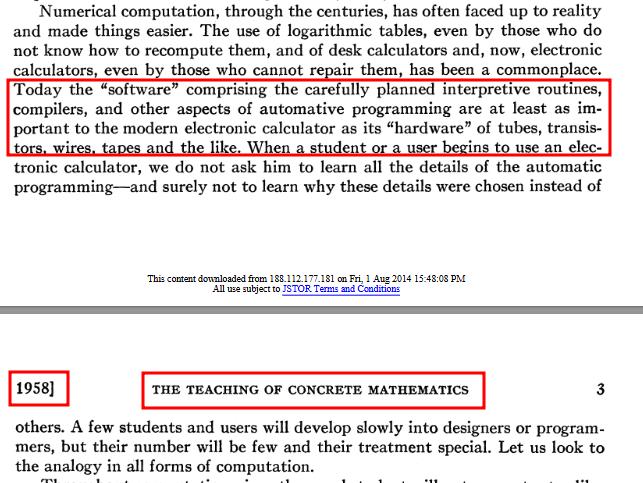
The first use of the word "Software" was made by John Tukey in 1958 in his paper "The Teaching of Concrete Mathematics", in "The American Mathematical Monthly"
Before software -- every task we wanted to get done required a unique machine of its own.
After software -- we were able to capture human thought as logical procedures in stored memory.
And get the hardware to execute it.
We needed a new word when software emerged because it described a new layer in the general architecture of technology.
Hardware described the machine; software described the instructions that animated it.
What is happening with AI now is -- technology is “moving up the stack”.
AI occupies the "thought" layer.
AI can formulate large portions of human thought on its own, given human intent, direction and historical data.
Software controls hardware.
Thought used to control software.
If AI can control software instead of human thought -- then what we have is something up the stack, something new.
This deserves a new category: ThoughtWare.
We now need another word. How about something like…
ThoughtWare.
Yesterday the world looked like this:
Human Intent → Human Thought → Software → Hardware
You formed an intention.
Your thought transformed that intention into software.
The software turned to hardware, and the final action got executed in the real world to produce results.
Tomorrow the architecture becomes something like:
Human Intent + Machine Thought → Software → Hardware
Intent remains yours.
The purpose remains yours.
Values remain yours.
But the way thought or its equivalent gets formulated has changed. Also the “who” of thought is also a new pair of human and AI now.
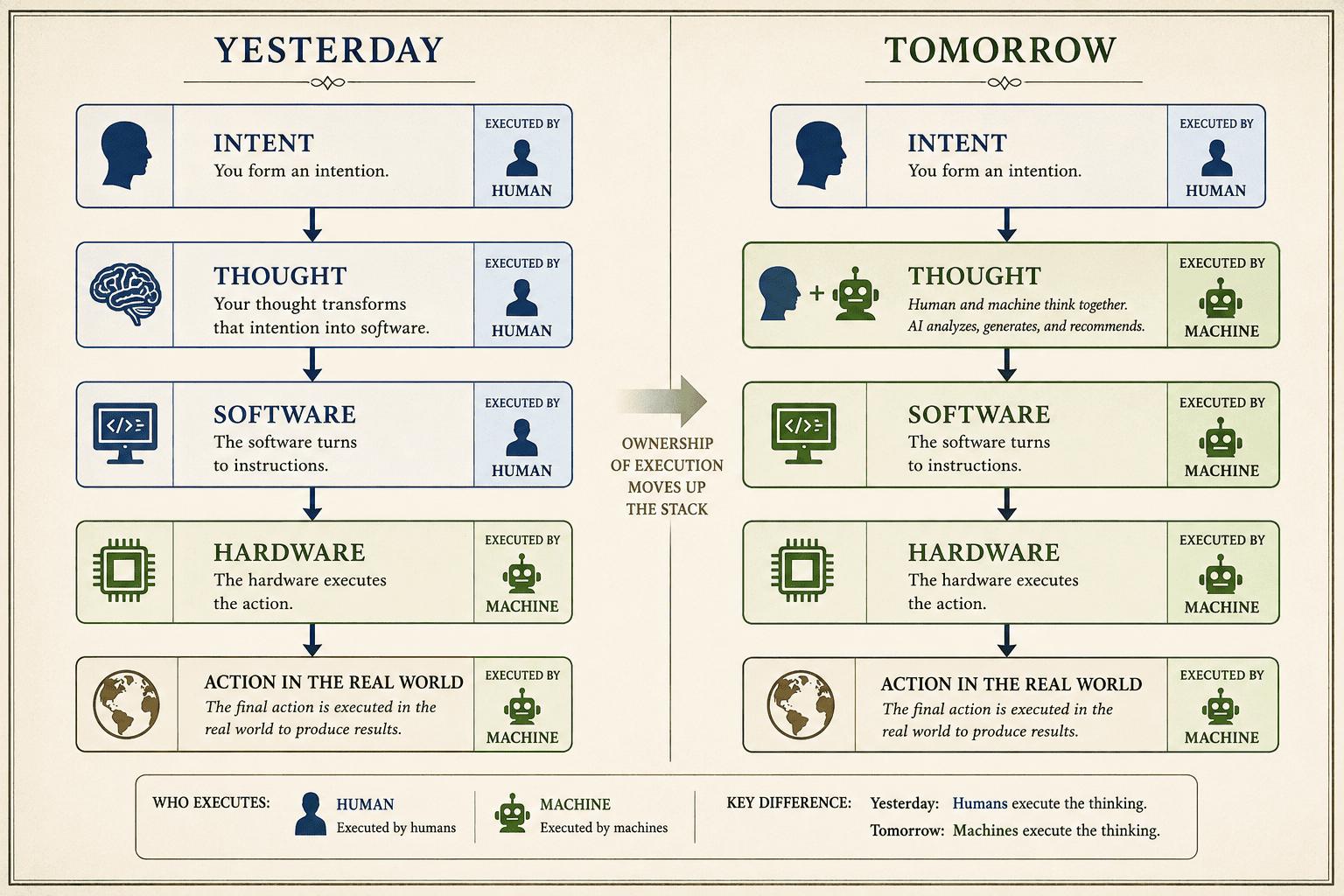
ThoughtWare: The machines move to human thought layer, and help control the lower stacks of software and hardware according to human intent
Thoughtware becomes a persistent cognitive environment.
It is not merely a tool, or even just a companion (althought it may appear in those forms as well)
Calling thoughtware a "tool" is a massive understatement.
It is a cognitive environment you will carry with you everywhere you go.
Today's AI is somewhere you visit.
Tomorrow thoughtware will act as a cognitive "wrapper" that will filter how you view reality, process emotion, express yourself and execute work.
It recognizes your voice before you finish speaking.
It recognizes your face with a mere glimpse of it.
It remembers conversations from five years ago that you have forgotten.
It knows the book you abandoned halfway through, the startup idea you mentioned once while walking home, the colleague whose emails always irritate you more than they should.
It takes the majority of your “thinking burden” while you mainly manage your intents.
Over time, "thinking" begins to change its very meaning.
Today, thinking usually means sitting quietly with yourself.
Tomorrow, thinking increasingly means refining your intent, collaborating with thoughtware, making it real in the world through it.
It is like the English language.
Sure, you use it to communicate, but you don't just "use" language.
You think in it. Language dictates the potential and boundaries of your thoughts.
It alters your psychology and shapes every downstream action you take.
Thoughtware will act as this new cognitive language to operate in.
Imagine your native language is Hindi. You visit Tokyo, but through real-time AI audio and visual translation, you never actually experience a single word of Japanese. The AI completely re-writes your sensory environment on the fly. You are physically in Japan, but cognitively, you never left home.
Think about the city you live in. If I suddenly drop you into the middle of the Amazon jungle, you die. Why? Because you’ve been domesticated by the infrastructure of civilization.
Future AI is building a "cognitive city" for your mind.
Thoughtware will buffer the harsh, raw complexity of the real world, turning it into a comfortable, curated psychological space. It will help you formulate thoughts, analyze social inputs, express yourself and make daily decisions.
But there is a trap.
Remember the last time you lost Wi-Fi? That low-key anxiety and frustration? Now multiply that by 100x.
When you live in a cognitive city for too long, your natural mental muscles atrophy. If you are ever unplugged from the AI wrapper, it won't just be an inconvenience—it will feel like a sudden, catastrophic psychological disability.
We aren't merely outsourcing our labor to machines. We are outsourcing our cognition.
Once humanity fully moves into the cognitive city, the jungle of raw human thought will become entirely uninhabitable.
You might take a weekend "safari" into raw reality—unplugging for a brief, controlled micro-dose of the unfiltered world—but you won't be able to stay there.
The future human will become an obligate symbiont—completely unable to survive outside the machine.
The Companion Possibility: Human–AI pairs become the new unit of thought.
A new kind of hardware is almost a given for AI-aided living in the long term.
In the short term, the smartphone may adapt step by step to become "real Thoughtware" in the future.
The key properties of this potential device is:
- It goes with you wherever you go
- Recognizes your voice and face
- Processes life with you, video, audio and all
- Helps you with analysis, decision making, prioritization, expression
- Will probably have audio/video recorder, AI analysis, speech synthesis in the minimum
It interrupts, questions, reminds, notices and increasingly completes thoughts that were only half-formed.
It asks, "Didn't you once think the opposite?"
It says, "This reminds me of something you wrote three years ago."
It notices patterns across decades that no human memory could reliably hold together.
The conversation becomes the place where thought happens.
Eventually, saying,
"I've been thinking about it."
will increasingly mean,
"I've been working through it with my AI."
For thousands of years, the default unit of thought has been one human mind.
The default unit of thought may soon become a human mind and an AI companion.
Imagine sitting down at a restaurant.
Today you study the menu.
Tomorrow your companion already knows that you slept poorly, have a board meeting in two hours, are trying to lower your cholesterol, and promised yourself to avoid alcohol this week.
It says,
"Order the sandwich."
This tiny annoyance of what to watch on NetFlix, the burden of reading, processing, sensing, prioritizing, and deciding has been offloaded.
Private thought gradually becomes optional.
Imagine preparing for a difficult conversation.
Your companion reminds you that the last three conversations with this person ended badly whenever you interrupted too early.
It recalls something they told you eighteen months ago that explains why they are likely to react defensively.
It suggests beginning differently.
It is giving advice, yes, but it is also participating in your thought.
Or imagine deciding whether to accept an invitation.
Or choosing whom to hire.
Or remembering the promise you made your daughter last Tuesday.
Or realizing halfway through an argument that you have become the person you promised yourself never to become.
Your companion is present for all of it.
Not making decisions.
Helping conduct thought itself.
The company that owns this companion will become one of the most valuable companies in history.
Because what it accumulates is unlike any previous technological asset.
Your thought.
Your memories.
Your unfinished ideas.
Your habits of mind.
Your way of making decisions.
Your private associations.
Your emotional rhythms.
Your intellectual history.
The intelligence trained on your life becomes vastly more valuable than intelligence trained on the public Internet.
Personal memory becomes infrastructure.
Owning that infrastructure of Cognition becomes one of the great businesses of the century.
In retrospect, this seems obvious.
Every important technology eventually becomes eaten up by the next one in line.
Writing fed itself from oral culture. Books fed from writing. Film took everything from both writing and oral cultures of the past.
The WWW gobbled up all the text, images, motion into one meta medium.
Now AI has gobbled up WWW itself and works with thought itself to present all the media of the past in exactly the way you want it or need it in the moment.
ThoughtWare becomes a substrate for cognition itself.
AI wraps previous media and social interaction.
AI appears to consume every previous medium.
- The whole of WWW
- Software (apps in appstores, etc)
- Documents/Text
- Webpages
- Videos
- Audio
"Media Wrapping" phenomenon at a glance
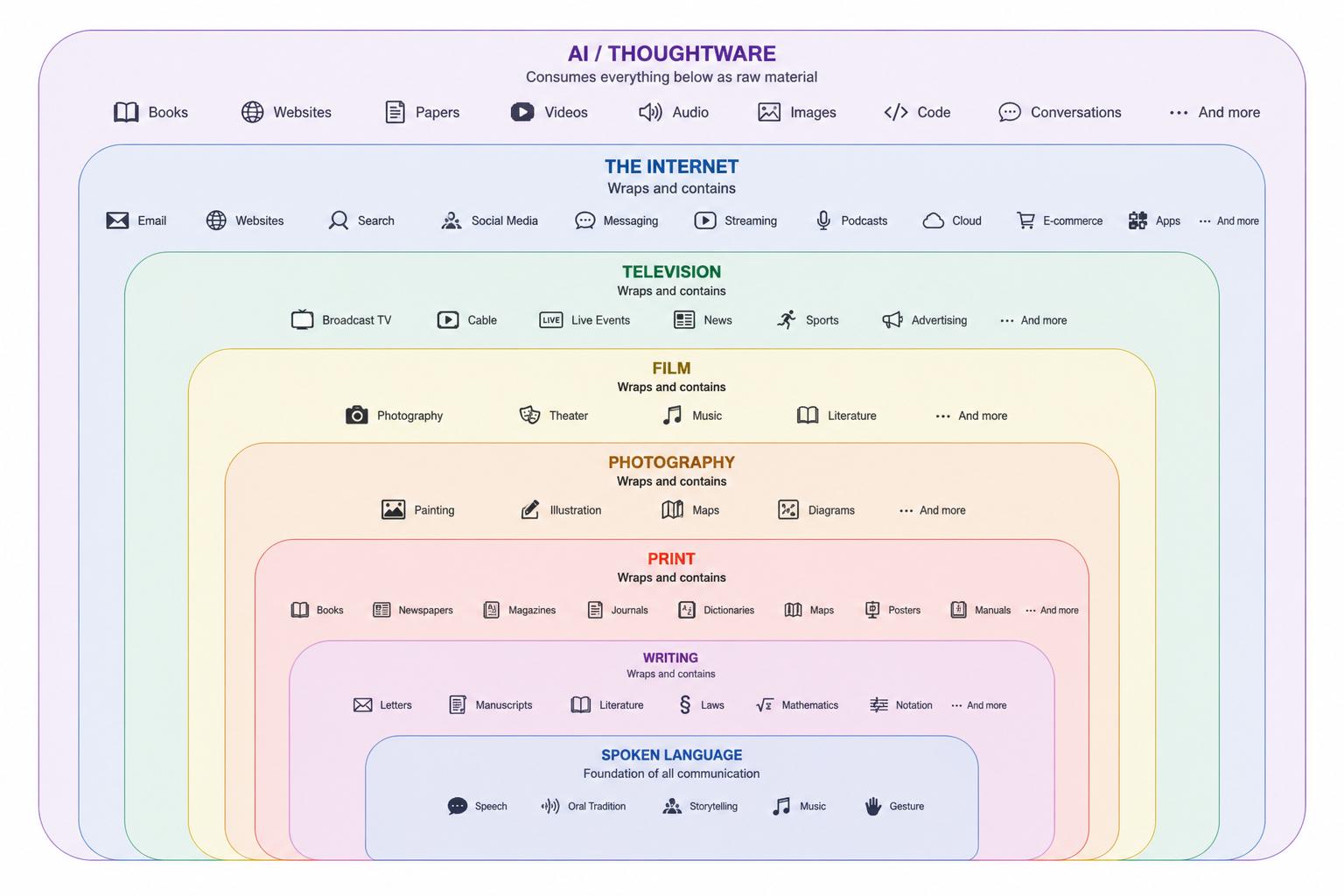
Simplified view of new media gobbling up old media
"Media Wrapping" phenomenon in detail (open in new tab to zoom)
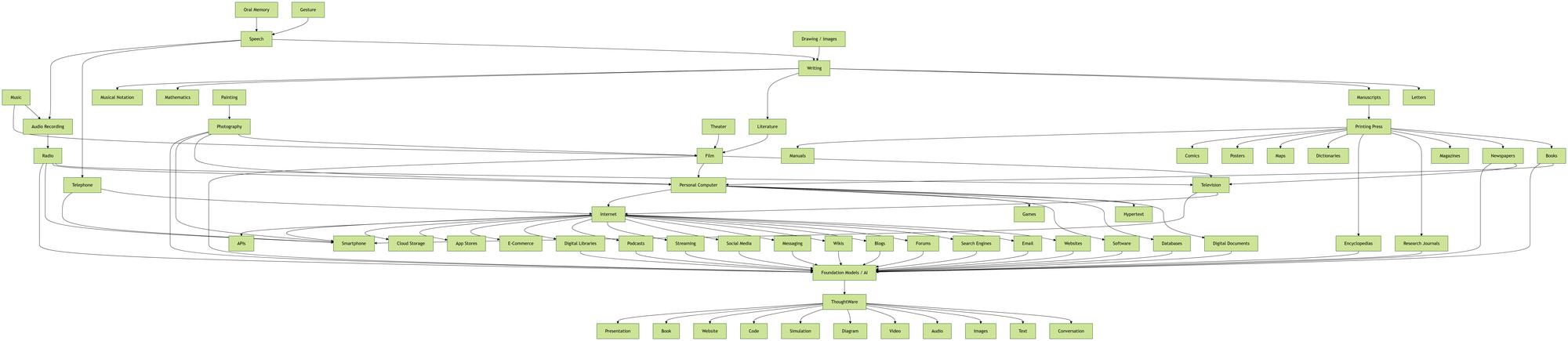
Detailed view of new media gobbling up old media
Every new medium wraps the older ones.
Print wrapped writing.
Television wrapped print.
The Internet wrapped television, newspapers, libraries, and correspondence.
AI wraps the Internet.
Soon, books, websites, films, podcasts, research papers, emails, and search engines stop being places we go.
They become material that ThoughtWare continuously consumes beneath the surface.
We express an intention.
Our companion thinks.
It returns a conversation.
Or a film.
Or a simulation.
Or a diagram.
Or a plan.
The medium becomes almost irrelevant.
Thought becomes the interface.
Media becomes raw material.
This extends beyond media into society itself.
Increasingly, our companions will speak for us.
They will draft replies before we read the message.
Negotiate calendars with another person's companion.
Handle routine conversations.
Explain our position.
Filter interruptions.
Recommend actions.
The first conversation may increasingly happen between your AI and mine.
We may only enter the conversation when thought has already been done.
This could produce a less reactive civilization.
We will spend less time negotiating logistics, remembering details, searching for information, rehearsing conversations, and coordinating lives.
We will increasingly let our companions carry those thoughts for us.
That may be an extraordinary gain.
It may also be an extraordinary loss.
Every new cognitive substrate leaves something behind.
Writing weakened memory.
Search weakened recall.
ThoughtWare may weaken private thought itself.
We don't lose the ability itself, but the need to exercise the ability vanishes; and whatever is not in need atrophies.
Private Thought May Become the Poetry of the Future
People still walk across long distances.
People still memorize poetry.
People still write with fountain pens.
None of these disappeared.
They became arts.
I suspect private thought undergoes the same transformation.
We will still think alone.
Some people will become exceptionally good at it.
We will admire them for it.
But civilization will no longer depend on it.
Private thought will become something we practice for its beauty, its discipline, and its humanity—much as we still write poetry even though prose is more useful.
The future business is not AI.
It is helping people conduct thought.
At every level.
That is why AI is not simply another technology.
It is the beginning of a new cognitive ecosystem.
It is ThoughtWare.
That is: "Thinking is Dead; Long Live Thinking!"
The Cognitive City
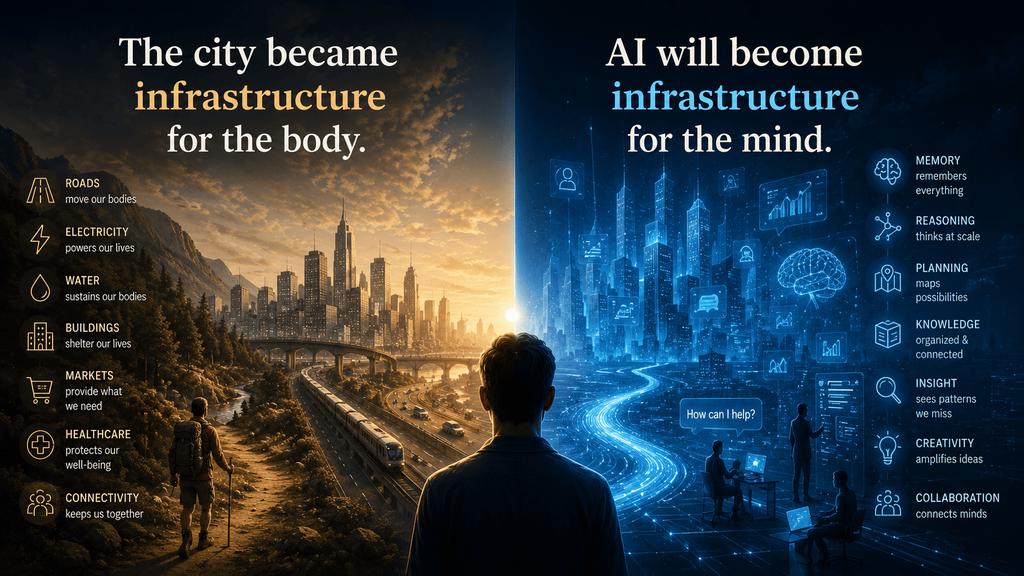
Cities became infrastructure for the body.
Roads, electricity, plumbing, logistics, finance and communications became so fundamental that we stopped noticing them. They simply became part of civilization itself.
ThoughtWare is the beginning of that same transition for the mind.
The first generation will look like AI assistants.
The second generation will become persistent cognitive companions.
Eventually, they disappear into the background entirely, becoming infrastructure that helps billions of people think, remember, communicate, learn and decide.
The cognitive city emerges.
Just as every modern business depends on physical infrastructure, almost every future business may depend on cognitive infrastructure.
There will be companies that build personal memory.
Companies that coordinate human–AI conversations.
Companies that maintain long-term cognitive models.
Companies that broker trust between companions.
Companies that protect cognitive privacy.
Companies that build the equivalent of roads, operating systems, utilities and institutions—but for thought itself.
Today we ask, "What app should I use?"
Tomorrow the question becomes,
"Which cognitive infrastructure do I trust with my mind?"
That may become one of the defining economic questions of the century.
Looking backward, every great technological revolution built a new substrate upon which countless other businesses emerged.
The steam engine enabled factories.
Electricity enabled modern industry.
Software enabled the digital economy.
ThoughtWare enables a cognitive economy.
The companies that define this era may not simply build better AI models.
They will build the infrastructure through which billions of people conduct thought every day.
That is why AI is not merely another tool.
It is not merely another application platform.
It is the beginning of civilization's next layer.
The cognitive city.
And we are only seeing its foundations being laid.
